
By Moe Magali
At Public Works Partners, our work sits at the intersection of public systems and community implementation. Across the country — and especially in cities like New York — we are seeing a defining shift in how neighborhoods evolve: nonprofits are increasingly shaping development, delivering services, and driving local change in ways once led primarily by government.
From affordable housing and workforce programs to climate resilience and public space stewardship, community-based organizations are now central actors in neighborhood transformation. Their growing role reflects both innovation in community leadership and a broader shift in public capacity.
As government agencies face fiscal pressures, staffing constraints, and increasingly complex social challenges, nonprofits are often stepping in to fill gaps in implementation and investment. This raises a critical question for cities and communities: what happens when nonprofits substitute for public systems, and how does that reshape neighborhoods? Understanding this shift is essential for anyone working in urban development, public policy, or community planning. It carries both enormous promise and significant structural implications for equity, accountability, and long-term neighborhood outcomes.
A Changing Model of Neighborhood Development
For much of the twentieth century, neighborhood change was largely driven by public agencies. Governments planned infrastructure, built housing, delivered services, and coordinated long-term investment strategies. While nonprofit organizations played important supporting roles, they were rarely primary implementers of neighborhood-scale change.
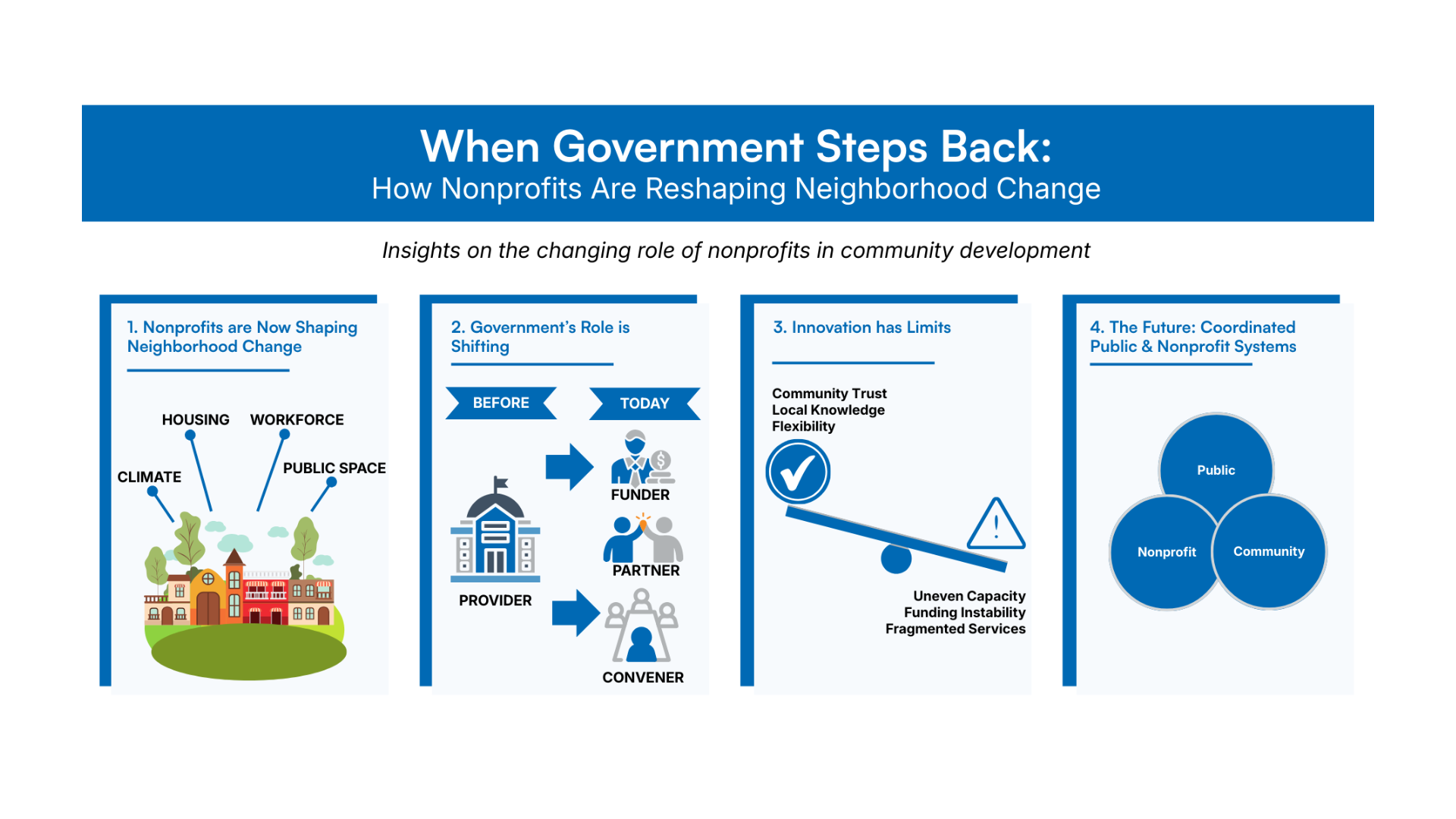
Today, that balance is shifting. Public agencies increasingly operate as funders, regulators, or conveners rather than direct providers, while community-based organizations have expanded their scope — designing programs, implementing capital projects, and managing long-term community assets.
In New York City, this transition is visible across multiple sectors. Affordable housing development increasingly relies on nonprofit developers and community development corporations to build and manage deeply affordable units. Public space stewardship is often led by nonprofit conservancies and community organizations that manage parks, waterfronts, and open spaces in partnership with the City. Workforce development and economic mobility programs are delivered largely through nonprofit intermediaries funded through public contracts. Neighborhood climate resilience initiatives — from green infrastructure to community preparedness — often depend on nonprofit leadership and community engagement.
This is not simply a programmatic shift. It represents a structural change in how cities function—and in who bears responsibility for neighborhood outcomes.
Several forces have contributed to this evolving landscape. Public agencies today operate under sustained fiscal pressure and growing demand. Cities are managing complex challenges — housing affordability, climate risk, economic inequality, and aging infrastructure — while navigating procurement constraints and limited implementation capacity. As a result, governments increasingly rely on external partners to deliver programs and services, and contracting models, public–private partnerships, and philanthropic investment streams have expanded the role of nonprofit organizations as frontline implementers.
In New York City, for example, social service delivery — including homelessness services, workforce training, and youth programs — is largely administered through nonprofit providers. Community-based organizations play central roles in neighborhood planning and rezoning engagement processes, and climate adaptation and environmental justice initiatives frequently rely on nonprofit partnerships to reach and engage vulnerable communities. The government has not disappeared from these processes, but its role has shifted from direct delivery to coordination and funding, creating space for nonprofit leadership to expand.
As their responsibilities grow, nonprofits are increasingly shaping the physical, social, and economic character of neighborhoods. They are developing affordable housing and protecting community land, supporting small businesses and connecting residents to jobs, stewarding parks and managing public spaces, and implementing environmental improvements. They provide health services, education support, and community stabilization programs that sustain neighborhood life.
In many communities, these organizations function as civic infrastructure — institutions that sustain community life, build social networks, and support local resilience. Consider the role of community-based organizations in New York City’s neighborhood development ecosystem. In areas undergoing significant change, such as East New York or parts of Upper Manhattan, local organizations have helped shape planning processes, guide resident engagement, and implement programs designed to mitigate displacement and expand economic opportunity. Similarly, nonprofit-led climate resilience initiatives across waterfront neighborhoods — from stormwater management projects to community preparedness programs — demonstrate how community organizations increasingly implement strategies once led primarily by public agencies. These efforts reflect the growing influence of nonprofits not only as service providers but as place-makers and development actors.
The rise of nonprofit leadership in neighborhood change brings important advantages. Community-based organizations often have deep relationships and trust within the neighborhoods they serve. They understand local dynamics, cultural context, and community priorities in ways that large public systems sometimes struggle to achieve. Their organizational structures can also enable greater flexibility and responsiveness, allowing them to pilot new approaches, test innovative models, and adapt quickly to emerging needs.
In practice, this has enabled meaningful progress — from community-driven housing solutions to locally tailored workforce programs — particularly in neighborhoods where traditional public systems have struggled to respond effectively. At their best, nonprofit-led initiatives strengthen community capacity alongside physical development, fostering participation, stewardship, and long-term resilience.
The Limits of Substitution — and the Need for Stronger Public–Nonprofit Systems
Yet the growing reliance on nonprofits to shape neighborhood outcomes also presents significant challenges. One concern is accountability. Public agencies operate within formal systems of democratic oversight, while nonprofit governance structures vary widely. As nonprofit influence expands, questions emerge about decision-making authority and public responsibility.
Uneven capacity presents another challenge. Neighborhoods with strong nonprofit ecosystems often attract greater investment and resources, while communities with fewer institutional assets may experience gaps in support — reinforcing existing inequities rather than addressing them. Funding stability also remains a persistent concern, as many nonprofit initiatives depend on short-term grants or philanthropic funding cycles, making long-term planning difficult and creating uncertainty for communities that rely on these services. At the same time, reliance on multiple independent actors can produce fragmented systems, where programs operate in parallel without coordination, limiting overall impact.
These structural risks highlight an important reality: nonprofits can supplement public systems, but they cannot fully replace sustained public investment and coordinated governance.
The rise of nonprofit-led development is therefore changing not only how services are delivered, but how neighborhoods evolve. Development priorities increasingly reflect what funding streams support rather than what long-term planning may require. Neighborhoods with strong institutional capacity — including well-resourced community organizations — often advance more quickly than those without. In this environment, neighborhood outcomes may depend as much on institutional presence as on community need, raising fundamental questions about equity, planning, and the future of urban governance.
The answer is not a return to purely government-led models, nor further retreat from public responsibility. Instead, cities must design systems that intentionally align public leadership and community-based implementation. Stronger approaches include long-term partnerships between public agencies and nonprofit organizations, funding structures that support community capacity, and coordinated planning processes that integrate local knowledge with public investment. Emerging models of neighborhood planning and community engagement in New York and other major cities demonstrate how collaborative approaches can strengthen both implementation and accountability, recognizing that sustainable neighborhood change requires shared responsibility across sectors.
At Public Works Partners, we see this moment as an opportunity to rethink how cities deliver equitable neighborhood outcomes. Nonprofits now play a defining role in shaping community development, strengthening civic infrastructure, and advancing local resilience. Their leadership reflects the power of community-based solutions — but also reveals the limits of substitution for public systems. The future of neighborhood change will not be determined by government or nonprofits alone. It will depend on how effectively we design systems that combine public accountability, community leadership, and sustained investment. When government and nonprofits work in partnership — rather than in substitution — neighborhoods are better positioned to grow, adapt, and thrive.
Moe Magali is the Director of Business Development & Strategy at Public Works Partners, a woman-owned urban planning and management consulting firm. He designs strategic, community-centered solutions that help governments, nonprofits, and institutions strengthen organizations and build more equitable, resilient communities. His work focuses on translating complex challenges into practical strategies that drive lasting neighborhood impact.