
The Excitement is Real, but so are the Questions
By Adi David
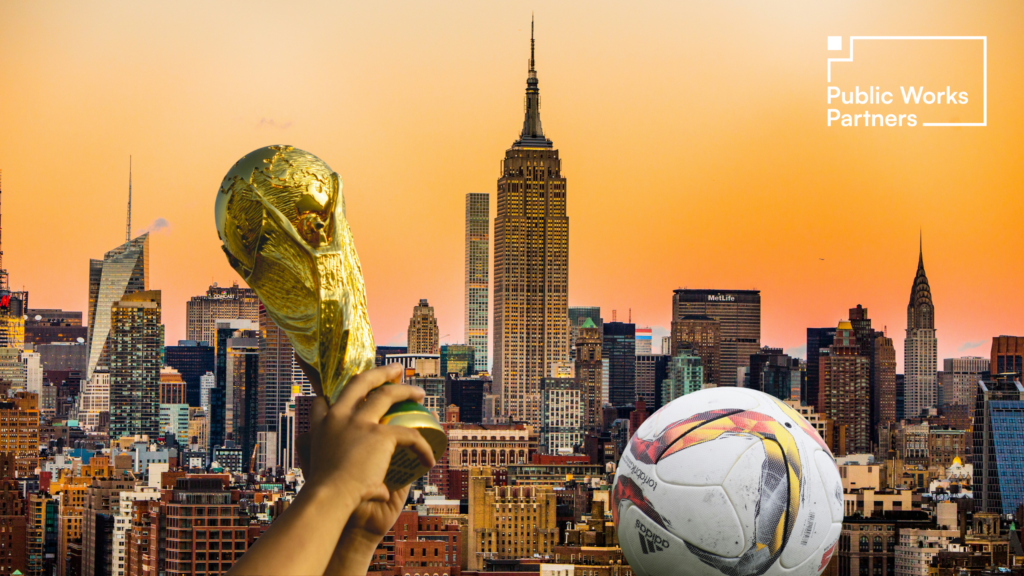
The world has come to New York City this summer, and the excitement is palpable. The FIFA World Cup is one of the largest sporting events on the planet, and for a few weeks this June and July, NYC will be at the center of it. That means packed stadiums, packed streets, and the kind of global spotlight the city genuinely thrives under.
For months before the opening whistle, planners, advocates, and community members have been circling the same question: when the world comes to your city, who actually benefits?
It’s an easy question to gloss over in the excitement. Mega-events come with big promises: economic boosts, infrastructure upgrades, and civic pride. Some of those promises are real. The history of major sporting events in cities tells a more complicated story. The benefits tend to concentrate in certain neighborhoods, certain industries, and certain income brackets. The burdens, like disruption, displacement, noise, and overcrowded transit, tend to fall elsewhere entirely.
We’re in the business of community impact, and that lens doesn’t switch off just because the occasion is a celebration instead of a crisis. The World Cup is a genuinely exciting opportunity for New York. We also think it’s worth asking the harder questions about how this city is managing it, and what a more equitable version of this moment could look like.
What “Benefit” Actually Means in this Context
Every time a major event comes to a city, officials and organizers roll out the same set of promises. Thousands of jobs created. Millions in tourism revenue. Infrastructure improvements that will outlast the event itself. Civic pride. Global visibility. These aren’t lies. The economic activity generated by a FIFA World Cup is genuinely significant, and New York is better positioned than almost any city in the world to capture it.
“Benefit” is doing a lot of work in those announcements, and it’s worth slowing down to ask: benefit measured how, and for whom?
A revenue spike for midtown hotels and sponsor-backed bars looks very different from sustained investment in the outer-borough neighborhoods that will actually absorb foot traffic and transit overcrowding. This is where it’s worth pushing one layer deeper than the outcomes themselves. Those different outcomes aren’t random, they’re produced by upstream decisions about procurement, contracting, and whose interests get represented in the planning process months before a single fan arrives. Who got the contracts, who got consulted, and who got a meeting on the calendar all shape who eventually gets the benefit. The distribution of benefit is a planning choice, not a natural byproduct of the event itself, and like all planning choices, it reflects priorities set well before opening day.
Fan Zones
Fan zones are the most visible and consequential planning decision in any major sporting event. They’re where the city literally decides to put the party, and everything about that decision carries equity implications.
Where are NYC’s fan zones located? Are they in neighborhoods with robust transit access, or are they concentrated in areas that are already well-served and well-resourced? Are they designed to be genuinely accessible: physically, linguistically, and financially? A fan zone with a $20 entry fee and signage only in English is not a public space. It’s a ticketed experience with a public relations strategy.
Then there’s the vendor question. Fan zones generate real commercial opportunity, and local food vendors, small businesses, and artists can benefit meaningfully from World Cup foot traffic, if they’re given genuine access. That access doesn’t happen by default. It depends on whether procurement processes proactively reach out to small and local vendors or simply default to the large corporate sponsors who already have a seat at the table. The difference between an opportunity that’s accessible and one that’s merely performative usually traces back to a decision made in a planning meeting, not a flaw in the neighborhood itself.
There’s also the question of what happens to these spaces after the tournament ends. Some of the best outcomes from major events come from temporary activations that reveal the latent potential of underused public space, and then stick around in some form. That requires intentionality and follow-through, not just goodwill at the ribbon-cutting.
The Foot Traffic Burden
Here’s something that rarely makes it into the press releases: hosting the world is disruptive. Street closures, rerouted buses, overwhelmed subway stations, noise, crowds, and the general chaos of moving millions of visitors through a city that is already, on a normal Tuesday, pretty overwhelming.
That disruption doesn’t land evenly. It lands hardest on the people with the least flexibility: residents who can’t just work from home during a street closure, small business owners who lose a week of regular foot traffic when their block gets cordoned off, transit-dependent commuters who absorb every service change in their body and their schedule.
It also lands hardest on communities with the least political capital to push back on poor planning decisions. When a fan zone gets sited in a neighborhood without meaningful community input, when a street closure is announced two weeks before it happens, when transit changes are poorly communicated. These are the result of planning processes that didn’t prioritize the people most affected.
This is also where trust starts to compound, in one direction or the other. Communities remember whether they heard about a decision early enough to weigh in, or only found out once the barricades went up. Credibility isn’t something you pitch, it’s something you prove one interaction at a time. The same is true at the neighborhood level. A mega-event doesn’t just test logistics. It tests relationships, and institutions spend or build trust through exactly these moments, whether they realize it or not.
What Good Planning Looks Like
To be clear, the point here isn’t that New York shouldn’t host the World Cup, or that the city hasn’t done good work preparing for it. NYC is one of the most logistically sophisticated cities in the world, and the people working on this have genuinely hard jobs. New York is highly capable, and it still has real choices to make about how this moment gets managed. Both things are true at once.
So what does thoughtful, equity-centered mega-event planning actually look like?
It starts with community engagement before siting decisions are made, not after the permits are filed. It includes local business inclusion that’s built into the procurement structure itself, with proactive outreach and technical assistance, not just an open application that assumes everyone has equal capacity to navigate it. It means accessible, multilingual public spaces, in a city as linguistically diverse as New York, that’s a baseline expectation, not a stretch goal. And running underneath all of it is a simple discipline borrowed straight from how PW thinks about client trust: lead with transparency about tradeoffs, make reliability visible through consistent follow-through, and hold to stated values even when it would be easier not to. Those same three levers that build trust with a client build trust with a neighborhood.
The research on past host cities backs this up. Germany’s 2006 World Cup is the case study planners point to again and again, largely because the country invested in transit and rail infrastructure that served real, pre-existing needs and kept paying dividends long after the tournament ended. Brazil 2014 is the cautionary tale in the other direction: stadiums built for the moment, several of which now sit underused, with little lasting benefit to the communities that hosted them. The difference between those two outcomes wasn’t luck. It was what each city chose to prioritize and follow through on.
The World Cup is a Test
New York City will pull off a great World Cup. That was never really in doubt. The stadiums will fill, the energy will be electric, and for a few weeks this summer the city will feel like the center of the universe.
However, great events and equitable events are not automatically the same thing. The cities that get this right are the ones that treat a mega-event not as an end in itself, but as a forcing function; a deadline that accelerates investments and improvements the city should have been making anyway, distributed across the communities that need them most.
The World Cup is a test. Not of whether New York can host. We know it can. The test is whether the neighborhoods that open their streets, absorb the crowds, and share their city with the world will still feel the benefit and thrive. That’s the question worth holding onto, long after the final whistle.