
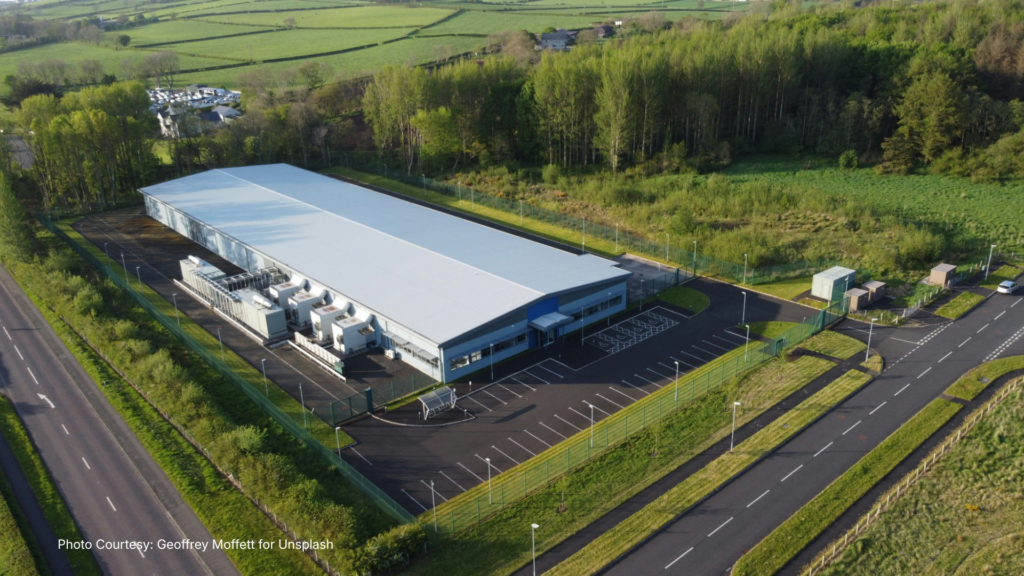
Artificial intelligence is transforming the economy at a pace few technologies have matched, and with it comes an unprecedented demand for digital infrastructure. Across the country, states are competing to attract hyperscale data centers, promising billions of dollars in private investment and positioning them as engines of economic growth and innovation. At the same time, governments are beginning to confront a more difficult reality: the facilities powering the AI economy require extraordinary amounts of electricity, water, land, and supporting infrastructure. The International Energy Agency projects that electricity demand from data centers will grow significantly over the coming decade as AI adoption accelerates, making decisions about where and how these facilities are built increasingly consequential.
New York’s recent decision to pause approvals for new hyperscale data centers while it develops stronger statewide standards reflects a broader shift in thinking. The debate is no longer simply about attracting investment or winning the AI race. It is about ensuring that the infrastructure supporting that growth also serves the public interest. That represents an important evolution in economic development policy—one that other states are likely to face as demand for AI infrastructure continues to grow.
The planning profession has already begun responding to this challenge. In its recent white paper, Local Guidelines for Data Center Development, the Urban Land Institute argues that data centers should no longer be treated as conventional industrial uses. Instead, communities should proactively establish policies to address land-use compatibility, infrastructure capacity, environmental impacts, utility coordination, and public engagement before projects are proposed. It is an important shift from reactive permitting to proactive planning.
But planning where data centers go is only part of the challenge.
The next question is what they should contribute.
For decades, economic development has measured success using familiar metrics: dollars invested, jobs created, and tax revenue generated. Those measures remain important, but they are increasingly incomplete for projects of this scale. A hyperscale data center can require hundreds of megawatts of electricity, substantial transmission upgrades, extensive cooling systems, and significant industrial land while employing relatively few permanent workers compared to other major economic development projects. If communities are expected to accommodate these facilities, they deserve more than construction activity and property tax revenue. They deserve lasting public value.
That is why New York has an opportunity to establish a new standard: Community Return on Infrastructure. Just as environmental impact statements have become an expected part of major development, large digital infrastructure projects should demonstrate how they improve the long-term health, resilience, and prosperity of the communities in which they are located. The Urban Land Institute has provided local governments with a roadmap for planning where data centers should be located. The next step is developing an equally rigorous framework for evaluating what they leave behind.
The first step should be requiring every hyperscale data center to prepare a Community Infrastructure and Readiness Plan before receiving state approval. Building on the Urban Land Institute’s recommendations for coordinated infrastructure planning, developers should demonstrate how their projects align with existing transmission capacity, renewable energy investments, water availability, transportation systems, and emergency services while also contributing to infrastructure improvements that benefit surrounding neighborhoods. Grid upgrades, battery storage, stormwater improvements, broadband expansion, and resilience investments should become part of the public legacy of every major project rather than infrastructure that serves only the facility itself.
Second, New York should require a Community Prosperity Agreement for projects above a defined threshold. Traditional community benefit agreements often focus on mitigating impacts after projects have already been designed. Instead, developers should commit to measurable investments in workforce development, apprenticeships, partnerships with schools and community colleges, procurement from local and minority-owned businesses, digital skills training, and neighborhood economic development. If artificial intelligence is expected to reshape the economy, the communities hosting its infrastructure should have a meaningful pathway to participate in that future.
Finally, New York should adopt a Healthy Communities Scorecard as part of the project review process. The Urban Land Institute emphasizes the importance of evaluating data centers within their broader community context rather than as stand-alone facilities. A Healthy Communities Scorecard would build on that principle by evaluating projects not only on environmental compliance and infrastructure demand but also on their contribution to community resilience, public health, energy affordability, climate goals, economic mobility, and quality of life. It would also evaluate the quality of community engagement itself, recognizing that trust is not simply a communications exercise but an essential component of successful infrastructure delivery.
One of the Urban Land Institute’s most important observations is that many communities are encountering data centers for the first time. Public concern often stems not only from legitimate questions about energy or land use but also from uncertainty about how these facilities operate and what they mean for a community’s future. That makes education and engagement as important as engineering. Communities should be invited into the conversation before sites are selected and permits are filed, allowing residents to help define what successful development should accomplish rather than limiting participation to reacting to completed proposals.
Some will argue that higher expectations will discourage investment. Experience suggests otherwise. Communities that establish clear rules, transparent processes, and predictable expectations often create greater certainty for both developers and residents. Public trust is not an obstacle to economic development—it is increasingly one of its most valuable assets.
This conversation extends well beyond data centers. The same questions will shape semiconductor manufacturing, battery production, logistics facilities, clean energy infrastructure, and other major investments that will define the next generation of the American economy. The future of economic development cannot be measured solely by the size of an investment or the speed of a permit. It must also be measured by the strength of the communities those investments help create. Artificial intelligence will undoubtedly transform our economy. The opportunity before New York is to ensure that the infrastructure powering that transformation also strengthens the places where people live, work, and raise their families. Planning for where data centers belong is essential. Planning for their contributions will ultimately determine whether the AI economy creates healthier, more resilient communities.