
If you want to understand what’s holding New York back, don’t look at the abandoned rail tracks running through central Queens. Look at the debate surrounding them.
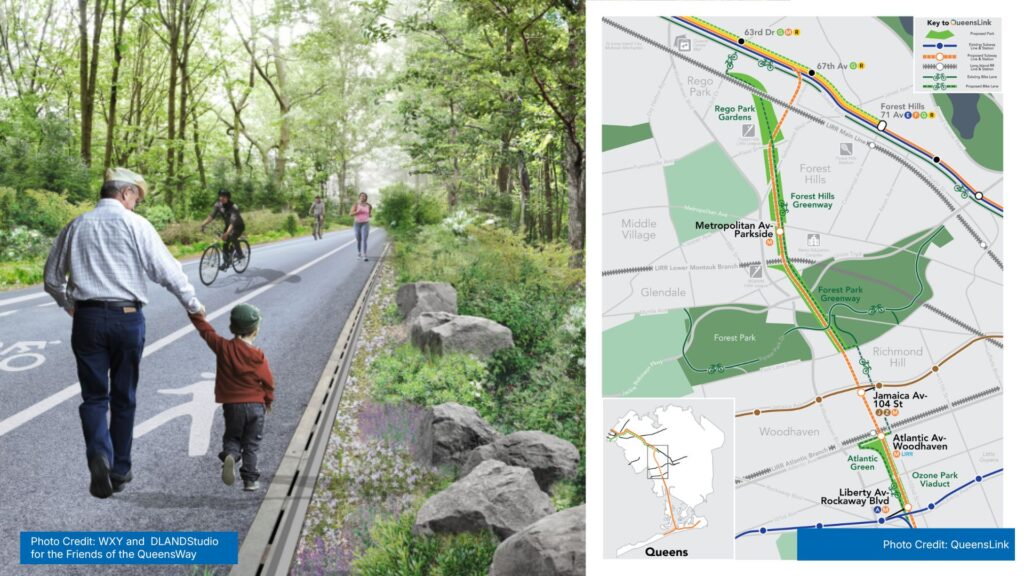
For years, New Yorkers have argued over two competing visions for the long-abandoned Rockaway Beach Branch. QueensLink would restore rail service along the corridor, reconnecting neighborhoods from Rego Park to Ozone Park to the subway system, reducing commute times, expanding transit access, and pairing new rail infrastructure with parkland and greenways. QueensWay would transform the same corridor into a linear park, creating new open space, walking and biking trails, and recreational amenities in neighborhoods that have long lacked sufficient parks. Both proposals are ambitious. Both would improve the quality of life. Both are backed by passionate advocates who care deeply about the future of Queens.
Yet somehow, we’ve convinced ourselves that New Yorkers must choose between them.
That should concern all of us.
The QueensLink versus QueensWay debate is being framed as a fight over transportation versus parks. It isn’t. It’s evidence that New York still plans like it’s the twentieth century—through agencies with narrow mandates, siloed budgets, and competing priorities rather than around the lived experience of residents. We continue asking communities to choose between investments that should be working together.
This isn’t simply a planning problem. It’s a leadership problem.
The challenges facing New York no longer fit neatly within the organizational chart at City Hall. Housing affordability, mobility, economic opportunity, public health, climate resilience, neighborhood vitality, and public safety are all interconnected. Every major public investment touches several of these issues at once. Yet our institutions continue to evaluate projects as if they exist in isolation. Transportation agencies focus on ridership. Parks departments focus on acreage. Economic development agencies focus on jobs. Each does exactly what it was created to do. The problem is that no one is accountable for delivering outcomes that improve communities as a whole.
The result is predictable. We spend years debating whether a project should solve one problem or another instead of demanding that it solve several. We force transit advocates to compete against park advocates. We ask neighborhoods to defend one public good at the expense of another. Then we wonder why major infrastructure projects take decades, become politically divisive, and leave everyone frustrated.
Cities around the world have moved beyond this way of thinking. The best infrastructure investments today are expected to accomplish multiple objectives simultaneously. A transportation project should also reduce emissions, improve public health, stimulate economic development, strengthen neighborhood connectivity, and create better public spaces. Likewise, parks are no longer judged solely by the number of acres they add, but by how they contribute to climate resilience, local business activity, physical and mental health, and social cohesion. In an era of limited public resources, every dollar invested should solve multiple problems.
New York should be leading this movement. Instead, we’re still asking the wrong question.
The question isn’t whether Queens deserves better transit or better parks.
It deserves both.
The question is whether New York’s political leadership is willing to modernize how government plans, funds, and delivers infrastructure. That means breaking down agency silos, aligning capital investments around shared outcomes instead of departmental mandates, and evaluating projects based on the total value they create—not just the box they fit into.
The future of the Rockaway Beach Branch matters. But what matters even more is what this debate says about our ability to tackle the next generation of challenges. If we can’t find a way to integrate transportation, public space, climate resilience, and economic opportunity along one of the city’s last remaining public infrastructure corridors, how will we address housing, waterfront resilience, or neighborhood revitalization at the scale New York requires?
New Yorkers deserve more than false choices. They deserve leaders willing to reject outdated thinking and build infrastructure that reflects how people actually live. Until we stop forcing communities to choose between great ideas, we’ll continue settling for outcomes that fall short of this city’s potential.